WELCOME To PROJECT CIRCUIT DESIGN

Search

Memaparkan catatan dengan label audio. Papar semua catatan

Isnin, Jun 03, 2013

Audio Circuit

LA3161 Preamplifier circuit 

LA3161 based Preamplifier circuit with explanation

Preamplifiers are used to amplify low level signals such as those from mikes, tape heads before they are fed into power amplifiers. Power amplifiers are generally less sensitive. Frequency response also can be suitably trimmed and modified at preamp stage. LA 3161 is one of those widely used in tape decks and amplifiers as a stereo preamplifier.LA3161 based Preamplifier circuit with explanationLA3161 based Preamplifier circuit with explanation

Block Diagram is shown in Figure. LA 3161 has two low noise preamplifiers with good ripple rejection on chip catering to stereo applications. External part count is low and Single In line (SIL))(Figure 43) package makes mounting easy. Wltile the operating voltage is 9V, the IC can tolerate voltages up to 18V. Typical input resistance is WOK and output resistance is 10K with an open loop gain of78dB. Block diagram of the IC is given below. Input is given at Pin 1 and 8, output is taken at Pin 3 and 6, and negative Feedback is given at Pin 2 and 7. Power is at Pin 5 and Pin 4 is the ground terminal. There is an internal voltage regulator.
Ready made PCBs, even populated PCBs are available using this very useful IC. You can still build one, with a Veroboard provided proper care is taken about the ground returns. It simply means that one should not connect ground terminals of output and input at the same place. This will create serious oscillations and normal hobbyist will be left in the woods. Please read general instructions for working with amplifiers in the end.

LA4555 Audio Amplifier circuit 

LA4555 Audio Amplifier mono circuit 300x276
LA4555 Audio Amplifier mono circuit1 300x276


Stereo circuit and mono circuit are given in schematic .LA 4555 is basically a stereo amplifier with 2.3 watts into 4 ohms speakers at a total distortion of 10%. With a bridge circuit, it can be configured as mono amplifier delivering 4.6 watts. It has an input impedance of 30K and gain of 51 dB. It has an excellent voltage range of 3 to 13 volts. Both mono and stereo circuits are shown here.
Pin out is given in Figure


LA4555 top view 300x165


Input is given at Pin 8 in the mono circuit and output is taken at Pin 11 through a capacitor (C7) of 470 uF to a speaker of 4 ohms. In the case of stereo circuit, input is given at 5 and 8 pins and output is taken out at 2 and 11 pins respectively for left and right channels through the blocking capacitors C4 and C7.
A detailed description of the pin out will help now and in the future.


In the stereo circuit,
C5, C2 are feedback capacitors, zohich dictate the lower cut off frequency.
CI, C6 are bootstrap capacitors. If the capacitor value is reduced from the recommended 47uF, output at flow frequencies falls.
Cll, CIO are oscillation blocking capacitors. Polyester film capacitors are preferable.
C7, C4 are output coupling capacitors. Lower cutoff frequency depends on their value and quality.
C3 is the ripple filter or decoupling capacitor.
C8, C9 are the power source capacitors.
R2, R2 are oscillation blocking resistors.


ICs dissipate heat as they dissipate more and more power at more and more voltages. The heat must be removed continuously such that IC operates at rated temperature. Failure to do so will result in thermal runaway. If the IC is well protected, output power will fall to a safe area. If not it will eventually fail and pack up. Copper foil area is made as large as possible in the vicinity ofIC to dissipate more heat.

Then heat sink, thermally conductive material such as copper or aluminum is mounted on IC to remove the heat as it develops. It must be of enough size. In case ofLA4555, the IC has fins which are soldered to the PCB and a small heat sink also can be soldered along with it. Solder copper heat sink as shown in the figure below. Aluminum cannot be easily soldered. Method of mounting heat sink is shown in Figure.


heat sink mounting 300x149

readmore: www.engineeringslash.com

Ahad, Mac 03, 2013

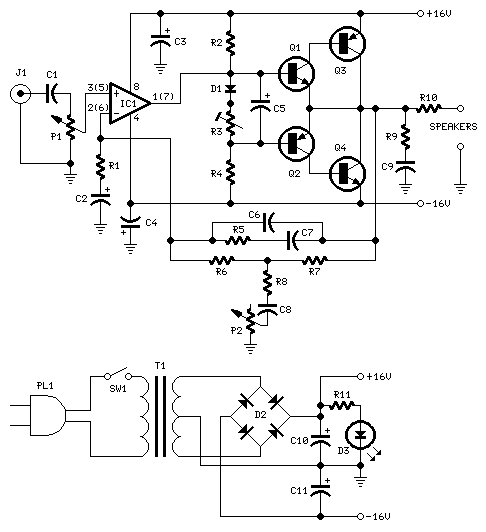
20Wpp Audio Amplifier with Bass


Audio circuit diagram

Parts:
P1 22K Log.Potentiometer (Dual-gang for stereo)
P2 100K Log.Potentiometer (Dual-gang for stereo)
R1 820R 1/4W Resistor
R2,R4,R8 4K7 1/4W Resistors
R3 500R 1/2W Trimmer Cermet
R5 82K 1/4W Resistor
R6,R7 47K 1/4W Resistors
R9 10R 1/2W Resistor
R10 R22 4W Resistor (wirewound)
C1,C8 470nF 63V Polyester Capacitor
C2,C5 100uF 25V Electrolytic Capacitors
C3,C4 470uF 25V Electrolytic Capacitors
C6 47pF 63V Ceramic or Polystyrene Capacitor
C7 10nF 63V Polyester Capacitor
C9 100nF 63V Polyester Capacitor
D1 1N4148 75V 150mA Diode

IC1 NE5532 Low noise Dual Op-amp

Q1 BC547B 45V 100mA NPN Transistor
Q2 BC557B 45V 100mA PNP Transistor
Q3 TIP42A 60V 6A PNP Transistor
Q4 TIP41A 60V 6A NPN Transistor
J1 RCA audio input socket


Power supply parts:
R11 1K5 1/4W Resistor
C10,C11 4700uF 25V Electrolytic Capacitors
D2 100V 4A Diode bridge
D3 5mm. Red LED
T1 220V Primary, 12 + 12V Secondary 24-30VA Mains transformer
PL1 Male Mains plug
SW1 SPST Mains switch
Comments:
This design is based on the 18 Watt Audio Amplifier, and was developed mainly to satisfy the requests of correspondents unable to locate the TLE2141C chip. It uses the widespread NE5532 Dual IC but, obviously, its power output will be comprised in the 9.5 - 11.5W range, as the supply rails cannot exceed ±18V.
As amplifiers of this kind are frequently used to drive small loudspeaker cabinets, the bass frequency range is rather sacrificed. Therefore a bass-boost control was inserted in the feedback loop of the amplifier, in order to overcome this problem without quality losses. The bass lift curve can reach a maximum of +16.4dB @ 50Hz. In any case, even when the bass control is rotated fully counterclockwise, the amplifier frequency response shows a gentle raising curve: +0.8dB @ 400Hz, +4.7dB @ 100Hz and +6dB @ 50Hz (referred to 1KHz).
Notes:
Can be directly connected to CD players, tuners and tape recorders.
Schematic shows left channel only, but C3, C4, IC1 and the power supply are common to both channels.
Numbers in parentheses show IC1 right channel pin connections.
A log type for P2 ensures a more linear regulation of bass-boost.
Don't exceed 18 + 18V supply.
Q3 and Q4 must be mounted on heatsink.
D1 must be in thermal contact with Q1.
Quiescent current (best measured with an Avo-meter in series with Q3 Emitter) is not critical.
Set the volume control to the minimum and R3 to its minimum resistance.
Power-on the circuit and adjust R3 to read a current drawing of about 20 to 25mA.
Wait about 15 minutes, watch if the current is varying and readjust if necessary.
A correct grounding is very important to eliminate hum and ground loops. Connect in the same point the ground sides of J1, P1, C2, C3 &C4. Connect C9 at the output ground.
Then connect separately the input and output grounds at the power supply ground.
Technical data:
Output power: 10 Watt RMS @ 8 Ohm (1KHz sinewave)
Sensitivity: 115 to 180mV input for 10W output (depending on P2 control position)
Frequency response: See Comments above
Total harmonic distortion @ 1KHz: 0.1W 0.009% 1W 0.004% 10W 0.005%
Total harmonic distortion @ 100Hz: 0.1W 0.009% 1W 0.007% 10W 0.012%
Total harmonic distortion @10KHz: 0.1W 0.056% 1W 0.01% 10W 0.018%
Total harmonic distortion @ 100Hz and full boost: 1W 0.015% 10W 0.03%
Max. bass-boost referred to 1KHz: 400Hz = +5dB; 200Hz = +7.3dB; 100Hz = +12dB; 50Hz = +16.4dB; 30Hz = +13.3dB
Unconditionally stable on capacitive loads

Popular Project

Another Project Blog

Project From Diff Blogger

Links

How to Find the other Websites of a Person?


DomainTools

Whois Source Logo


BetterWhois.com: Search ALL Domain Registrars

Webcams.travel - The Webcam Community - Home