WELCOME To PROJECT CIRCUIT DESIGN

Search

Memaparkan catatan dengan label multiveberator. Papar semua catatan

Khamis, Julai 11, 2013

Astable 555 Multivibrator


Astable 555 Multivibrator  


freq  Hzperiod Secduty cycle
Power
Ra 


Rb 


Ct 


LED1


LED2


Above in Gadget form, Astable 555 Multivibrator Gadget , for your Webpage or Google Home Page.
These are the formulae used by 555 and same is used in javascript without any change.

T1 = 0.693 (Ra + Rb) * Ct   charge time of Ct 

T2 = 0.693 (Rb * Ct)  discharge time of Ct

T = T1 + T 2    total period in seconds

F = 1 / T = 1.44 / ((Ra + (2 * Rb)) * Ct)   Frequency in Hertz

D = T 2 / T  duty cycle, multiply by 100 to get %.

Ct in farads and Ra-Rb in ohms.
The max power dissipation of 555 is 700mW so overload of more than 200mA will damage the device, connecting the battery in the reverse or wrong polarity will also damage device, ensure also Ra and Rb do not go less than 2.2K (use 4.7K minimum) as it may damage the discharge transistor at pin 7. The supply voltage can go upto 18V. For CMOS 555 like 7555 see the datasheet they are different.
the above circuit in pdf format  del00018.pdf
the cadsoft eagle source of the circuit  del00018.zip


datasheet of LM555 here pdf.
pdf links may take time to load in the browser, save file target to your disk is better.
If LEDs are not lighting up, refresh the page. Tested in Mozilla 1, Opera 5 and IE5 with javascript and images enabled.


Press the Red button below to turn on the circuit press it again to turn off. The 555 can source (LED2) or Sink (LED1) upto 200mA. It can even drive a small motor or lamp with diodes added to protect from inductive kickback.
Vary Ra, Rb and Ct with the controls given and see the change of frequency, period and duty cycle.


Khamis, Mei 16, 2013

How to make an Astable or Free running Multi vibrator using 741 Op-Amp ?

Square Wave Generator using Op-Amp


op amp astable multi vibrator
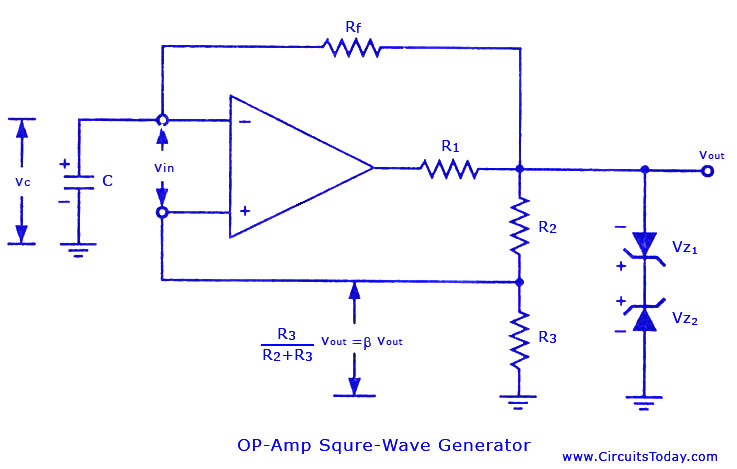
The non-sinusoidal waveform generators are also called relaxation oscillators. The op-amp relaxation oscillator shown in figure is a square wave generator. In general, square waves are relatively easy to produce. Like the UJT relaxation oscillator, the circuit’s frequency of oscillation is dependent on the charge and discharge of a capacitor C through feedback resistor R,. The “heart” of the oscillator is an inverting op-amp comparator
The compa­rator uses positive feedback that increases the gain of the amplifier. In a comparator circuit this offer two advantages. First, the high gain causes the op-amp’s output to switch very quickly from one state to an­other and vice-versa. Second, the use of positive feedback gives the circuit hysteresis. In the op-amp square-wave generator circuit given in figure, the output voltage vout is shunted to ground by two Zener diodes Z1 and Z2 connected back-to-back and is limited to either  VZ 2 or –VZ 1. A fraction of the output is fedback to the non-inverting (+) input terminal. Combination of IL and C acting as a low-pass R-C circuit is used to integrate the output voltage vout and the capacitor voltage vc is applied to the inverting input terminal in place of external signal. The differential input voltage is given as vin = vc - β vout
When vin is positive, vout = – Vz1 and when vin is negative vout = + Vz 2. Consider an instant of time when vin < 0. At this instant vout = + Vz 2 , and the voltage at the non-inverting (+) input terminal is  β Vz 2 , the capacitor C charges exponentially towards Vz 2, with a time constant Rf C. The output voltage remains constant at Vz 2 until vc equal β Vz 2.
When it happens, comparator output reverses to – Vz 1. Now vc changes exponentially towards -Vz1 with  the  same  time  constant  and  again  the  output  makes  a  transition  from -Vz1 to + Vz 2. when vc equals -βVz 1
Let    Vz1 = Vz 2
The time period, T, of the output square wave is determined using the charging and discharging phenomena of the capacitor C. The voltage across the capacitor, vc when it is charging from – B Vz to + Vz is given by
Vc = [1-(1+β)]e-T/2τ
Where τ = RfC
The waveforms of the capacitor voltage vc and output voltage vout (or vz) are shown in figure.
When t = t/2
Vc = +β Vz or + β Vout
Therefore β Vz = Vz [1-(1+β)e-T/2τ]
Or e-T/2τ = 1- β/1+ β
Or T = 2τ loge 1+β/1- β = 2Rf C loge [1+ (2R3/R2)]
Square Wave Generator Waveforms using 741IC
The frequency, f = 1/T , of the square-wave is independent of output voltage Vout. This circuit is also known as free-running or astable multivibrator because it has two quasi-stable states. The output remains in one state for time T1 and then makes an abrupt transition to the second state and re­mains in that state for time T2. The cycle repeats itself after time T = (T1 + T2) where T is the time period of the square-wave.
The op-amp square-wave generator is useful in the frequency range of about 10 Hz -10 kHz. At higher frequencies, the op-amp’s slew rate limits the slope of the output square wave. The symmetry of the output waveform depends on the matching of two Zener diodes Z1 and Z2. The unsymmetrical square-wave (T1 not equal to t2) can be had by using different constants for charging the capacitor C to +Vout and -Vout

How to make an Astable or Free running Multi vibrator using 741 Op-Amp ?


op amp astable multi vibrator
The non-sinusoidal waveform generators are also called relaxation oscillators. The op-amp relaxation oscillator shown in figure is a square wave generator. In general, square waves are relatively easy to produce. Like the UJT relaxation oscillator, the circuit’s frequency of oscillation is dependent on the charge and discharge of a capacitor C through feedback resistor R,. The “heart” of the oscillator is an inverting op-amp comparator
The compa­rator uses positive feedback that increases the gain of the amplifier. In a comparator circuit this offer two advantages. First, the high gain causes the op-amp’s output to switch very quickly from one state to an­other and vice-versa. Second, the use of positive feedback gives the circuit hysteresis. In the op-amp square-wave generator circuit given in figure, the output voltage vout is shunted to ground by two Zener diodes Z1 and Z2 connected back-to-back and is limited to either  VZ 2 or –VZ 1. A fraction of the output is fedback to the non-inverting (+) input terminal. Combination of IL and C acting as a low-pass R-C circuit is used to integrate the output voltage vout and the capacitor voltage vc is applied to the inverting input terminal in place of external signal. The differential input voltage is given as vin = vc - β vout
When vin is positive, vout = – Vz1 and when vin is negative vout = + Vz 2. Consider an instant of time when vin < 0. At this instant vout = + Vz 2 , and the voltage at the non-inverting (+) input terminal is  β Vz 2 , the capacitor C charges exponentially towards Vz 2, with a time constant Rf C. The output voltage remains constant at Vz 2 until vc equal β Vz 2.
When it happens, comparator output reverses to – Vz 1. Now vc changes exponentially towards -Vz1 with  the  same  time  constant  and  again  the  output  makes  a  transition  from -Vz1 to + Vz 2. when vc equals -βVz 1
Let    Vz1 = Vz 2
The time period, T, of the output square wave is determined using the charging and discharging phenomena of the capacitor C. The voltage across the capacitor, vc when it is charging from – B Vz to + Vz is given by
Vc = [1-(1+β)]e-T/2τ
Where τ = RfC
The waveforms of the capacitor voltage vc and output voltage vout (or vz) are shown in figure.
When t = t/2
Vc = +β Vz or + β Vout
Therefore β Vz = Vz [1-(1+β)e-T/2τ]
Or e-T/2τ = 1- β/1+ β
Or T = 2τ loge 1+β/1- β = 2Rf C loge [1+ (2R3/R2)]
Square Wave Generator Waveforms using 741IC
The frequency, f = 1/T , of the square-wave is independent of output voltage Vout. This circuit is also known as free-running or astable multivibrator because it has two quasi-stable states. The output remains in one state for time T1 and then makes an abrupt transition to the second state and re­mains in that state for time T2. The cycle repeats itself after time T = (T1 + T2) where T is the time period of the square-wave.
The op-amp square-wave generator is useful in the frequency range of about 10 Hz -10 kHz. At higher frequencies, the op-amp’s slew rate limits the slope of the output square wave. The symmetry of the output waveform depends on the matching of two Zener diodes Z1 and Z2. The unsymmetrical square-wave (T1 not equal to t2) can be had by using different constants for charging the capacitor C to +Vout and -Vout

Isnin, April 15, 2013

12VDC to 220V 50Hz 500W Inverter Circuit


This is circuit Inverter 12VDC to 220V 50Hz 500W.
It easy to make and Low cost. Friends favorite circuit about the the inverter, because like working outdoors, or to backup storage to use when necessary. Most of this is circuit low power, which is not suitable for practical applications. My friends said that he would be about 500 Watt.
It is a good size. Use with television receivers and light bulbs as well. When looking for circuit. I get headaches. If you are a beginner or I can not buy expensive good quality circuits. Requires only one transistor. Or if you have free time. I want to build old circuit is alive again. This circuit will accommodate all your needs. It is a simple circuit. 
https://blogger.googleusercontent.com/img/b/R29vZ2xl/AVvXsEiZC38unjeX-vPbjuvl_ZjayIojvqYNMRmvUDzkMTVbBFq0EZqN4W4m2LdV2mBO147D7LiHJeGXEnItnyKei1imocZRXJ-WIL0hhoznw8iJ_ykCiJTHHEKpLCMtpIGFZbdEr0I_rpO06gYM/s1600/Inverter+12VDC+to+220V+50Hz+500W.jpg


The same principle, I take battery voltage 12V to produce a oscillator about 100 Hz and pass to a two frequency divider circuit is only 50HZ. And drive a 10 ampere transformer with 10 x 2N3055 transistor in parallel. By a single transistor has 2A, when I use 10 transistors or 5 pairs of drive high current output. The complexity of circuit, but the principle is not it, and it is the number of transistors on a basic, easy to buy. You may be modified 100 watt power inverter To the size of transistors and transformers as well.
Source:circuitschematicelectronics

Popular Project

Another Project Blog

Project From Diff Blogger

Links

How to Find the other Websites of a Person?


DomainTools

Whois Source Logo


BetterWhois.com: Search ALL Domain Registrars

Webcams.travel - The Webcam Community - Home