WELCOME To PROJECT CIRCUIT DESIGN

Search

Memaparkan catatan dengan label 1-12VDC Output. Papar semua catatan

Khamis, Mei 09, 2013

Interfacing LED and push button switch to 8051


This article is all about how to interface push button switches to an 8051 microcontroller. Push button switches are widely used in embedded system projects and the knowledge about  interfacing them to  8051 is very essential in designing such projects. A typical push button switch has two active terminals that are normally open and these two terminals get internally shorted when the push button is depressed. Images of a typical pushbutton switch is shown below.
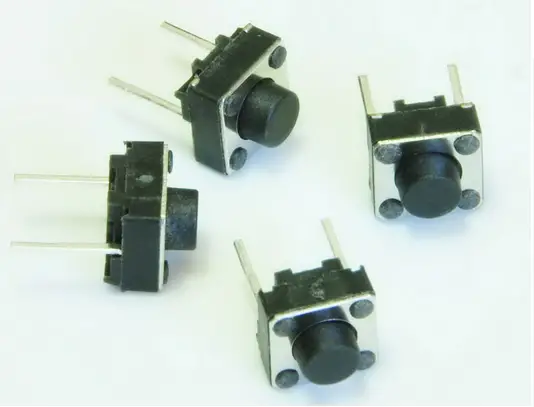
interfacing pushbutton to 8051
Pushbutton switch

Circuit diagram.

interfacing pushbutton to 8051 circuit
Interfacng 8051 and pushbutton
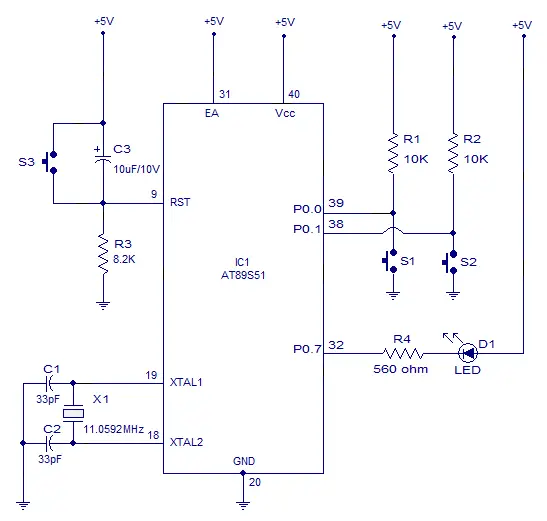
The circuit diagram for interfacing  push button switch to 8051 is shown above. AT89S51 is the microcontroller used here. The circuit is so designed that when push button S1 is depressed the LED D1 goes ON and  remains ON until push button switch S2 is depressed and this cycle can be repeated. Resistor R3, capacitor C3 and push button S3 forms the reset circuitry for the microcontroller. Capacitor C1, C2 and crystal X1 belongs to the clock circuitry. R1 and R2 are  pull up resistors for the push buttons. R4 is the current limiting resistor for LED.

Program.

MOV P0,#83H // Initializing push button switches and initializing LED in OFF state.
READSW: MOV A,P0 // Moving the port value to Accumulator.
RRC A // Checking the vale of Port 0 to know if switch 1 is ON or not
JC NXT // If switch 1 is OFF then jump to NXT to check if switch 2 is ON
CLR P0.7 // Turn ON LED because Switch 1 is ON
SJMP READSW // Read switch status again.
NXT: RRC A // Checking the value of Port 0 to know if switch 2 is ON or not
JC READSW // Jumping to READSW to check status of switch 1 again (provided switch 2 is OFF)
SETB P0.7 // Turning OFF LED because Switch 2 is ON
SJMP READSW // Jumping to READSW to read status of switch 1 again.
END
 

 The Logic 

The first instruction – MOV P0 #83H  - is to turn LED off (Hex 83 in binary = 10000011) and to initialize switches 1 and 2. Switch 1 is connected to port 0.0 and switch 2 is connected to port 0.1. Also note that LED is connected to port 0.7. 
Note:- Po.0 = 1 means switch 1 is OFF and Po.1 = 1 means switch 2 is OFF.  P0.0 = o means switch 1 is ON and p0.1 = o means switch 2 is ON. LED turns ON when P0.7 = 0 and turns OFF when P0.7 = 1
The program has two labels – READSW and NXT. It’s all about reading switch values – that is P0.0 and P0.1. We are using RRC instruction to read switch values. The values of port 0 is moved to accumulator. Since port 0 and 1 are used to interface switches 1 and 2, we can get the values of both port bits in LSB”s 0 and 1 of accumulator by using MOV A,P0 instruction. RRC – means – rotate right through carry. You can learn more about this instruction here –  8051 programming tutorial 1 . What RRC do is simple – it will move value of port 0.0 to the carry bit. Now we can check the carry bit using instruction JC – which means “jump if carry is set” . If carry is SET – then it means port0.0 =1 and this means switch 1 is OFF. If switch 1 is OFF then we have to check status of switch 2 and that is why we jump to label NXT. 
In the mean time if switch 1 is pressed – then value of port 0.0 will be equal to zero. This will get moved to accumulator and hence an RRC will result in carry bit = o. If carry bit = 0 then result of executing JC instruction is negative and it will not jump. The next instruction will get executed – that is CLR P0.7. This clears port 0.7 to zero and hence LED will turn ON. Once turned On- LED will be kept On until switch 2 is pressed. 
The status of switch 2 is checked in NXT label. When NXT is executed, we are using RRC for the second time consecutively.  This means, the carry bit now holds the value of P0.1 – which is status of switch 2. If carry bit = 1 then switch 2 is OFF. This means LED should not be turned OFF. If carry bit = 0 then LED should be turned OFF (The instruction SETB P0.7 turns LED OFF)

Toggling 2 LED with a  pushbutton using interrupt.

This circuit demonstrates how to toggle two LEDs  with a single push button using the external interrupts. Interrupt is an asynchronous signal (either hardware or software) which indicates the processor to make a change in current execution. When the processor receives a valid interrupt signal it saves the current state and then goes  to execute a set of predefined steps  called interrupt service routine (ISR). After executing  ISR, the processor goes back to the point where it deviated and continues from there. To learn more about interrupts check this link. External interrupt handling in 8051.

Circuit diagram. 
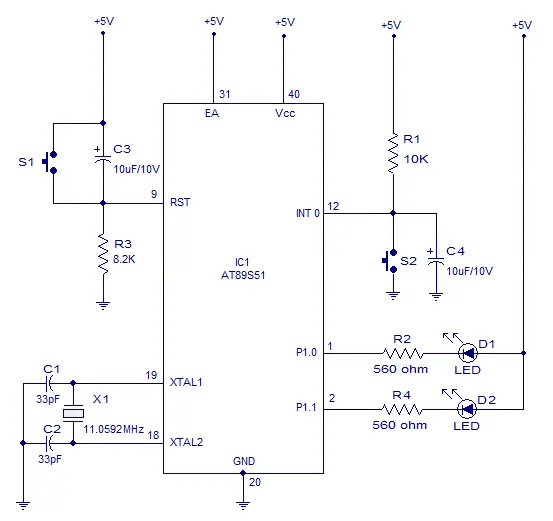
toggling led 8051 using interrupt
Toggling LED using 8051 with interrupt
 In the circuit shown above  D1, D2 (the LEDs  to be toggled) are connected to P1.0 and P1.1 respectively. R2 and R4 limits the current through the LEDs. The push button switch S2 is connected to the INT0 pin where R1 is a pull up resistor and C4 is the debouncing capacitor. C3, R3 and S3 forms the reset circuitry. Capacitors  C2, C2 and crystal X1 are related to the clock circuitry.  When powered ON LED D1 will be OFF and and LED D2 will be ON. Whenever push button switch S2 is pressed it creates an interrupt and the software makes the status of P1.o and P1.1 to toggle which gets reflected in the LEDs. 

Program.

ORG 000H // starting address
SJMP LABEL //jumps to the LABEL
ORG 003H // starting address for the ISR(INT0)
ACALL ISR // calls the ISR (interrupt service routine)
RETI // returns from the interrupt
LABEL: MOV A,#10000000B // sets the initial stage of the LEDs (D1 OFF & D2 ON)
MAIN: // main function that sets the interrupt parameters
SETB IP.0 // sets highest priority for the interrupt INT0
SETB TCON.0 // interrupt generated by a falling edge signal at INT0 (pin12)
SETB IE.0 // enables the external interrupt
SETB IE.7 // enables the global interrupt control
SJMP MAIN // jumps back to the MAIN subroutine
ISR: // interrupt service routine
CPL A // complements the current value in accumulator A
MOV P1,A // moves the current accumulator value to port 1
RET // jumps to RETI
END
If you come across any doubts/errors while implementing this circuit, please feel free to ask in our comments section.

This article shows how to interface a DC motor to an 8051 microcontroller. Interfacing DC motor to 8051 forms an essential part in designing embedded robotic projects. A well designed 8051-DC motor  system  has essentially two parts. Firstly an 8051 with the required software to control the motor and secondly a suitable driver circuit. Most of the DC motors have  power requirements well out of the reach of a microcontroller and more over the voltage spikes produced while reversing the direction of rotation could easily damage the microcontroller. So it is not wise to connect a DC motor directly to the microcontroller. The perfect solution is to use a motor driver circuit in between the microcontroller and the DC motor.

L293 motor driver.

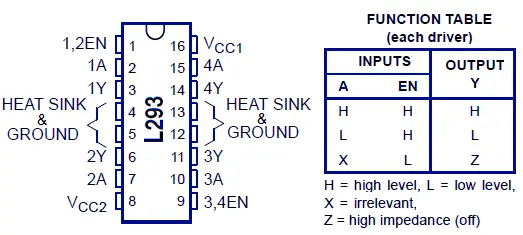
L293 is a dedicated quadruple half H bridge motor driver IC available in 16 pin package. To know more about H bridge, check this link. H bridge motor driver circuit. L293 has a current capacity of  600mA/channel and has supply voltage range from 4.5 to 36V DC. They are fitted with internal high speed clamp diodes for inductive spike protection. Other good features of L293 are high noise immunity, internal ESD protection, thermal shutdown, separate input supply for each channel etc. The pinout and truth table of an L293 motor driver is shown in the figure below.
L293 pinout and truth table
L293 pinout and function diagram

Bi directional DC motor using 8051.

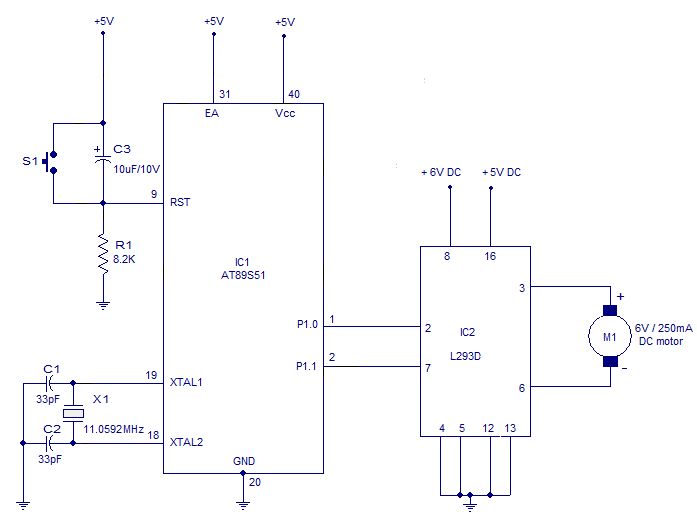
This project describes a bidirectional DC motor that changes its direction automatically after a preset amount of time  (around 1S).  AT89S51 is the microcontroller used here and L293 forms the motor driver. Circuit diagram is shown below.
bidirectional dc motor 805
Bi directional DC motor using 8051
In the circuit components R1, S1 and C3 forms a debouncing reset circuitry. C1, C2 and X1 are related to the oscillator. Port pins P1.0 and P1.1 are connected to the corresponding input pins of the L293 motor driver. The motor is connected across output pins 3 and 6 of the L293. The software is so written that the logic combinations of  P1.0 and P1.1 controls the direction of the motor. Initially when power is switched ON, P1.0 will be high and P1.1 will be low. This condition is maintained for a preset amount of time (around 1S) and for this time the motor will be running in the clockwise direction (refer the function table of L293). Then the logic of P1.0 and P1.1 are swapped and this condition is also maintained for the same duration . This makes the  motor to run  in the anti clockwise direction for the same duration and the entire cycle is repeated.

Program.

ORG 00H // initial starting address
MAIN: MOV P1,#00000001B // motor runs clockwise
ACALL DELAY // calls the 1S DELAY
MOV P1,#00000010B // motor runs anti clockwise
ACALL DELAY // calls the 1S DELAY
SJMP MAIN // jumps to label MAIN for repaeting the cycle
DELAY: MOV R4,#0FH
WAIT1: MOV R3,#00H
WAIT2: MOV R2,#00H
WAIT3: DJNZ R2,WAIT3
DJNZ R3,WAIT2
DJNZ R4,WAIT1
RET
END

Bidirectional motor with pushbutton control.

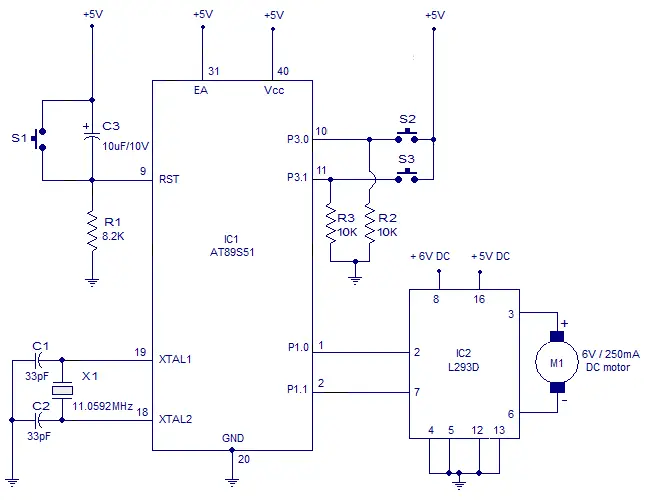
The circuit shown below is of an 8051 based  bi directional motor  whose direction can be controlled using 2 push button switches. The circuit is very similar to the previous one except  for the  two push button switches . These pushbutton switches are interfaced to  P0rt 3 of the microcontroller. Resistors R2 and R3 are the pull down resistors for P3.0 and 3.1 respectively.
bi directional DC motor push button controlled
Push button controlled bi-directional DC motor
 The code for the above project is so written that initially when power is switched ON, the motor remains OFF. When push button switch S2 is pressed P1.0 goes high and P1.1 remains low. The motor runs in the clockwise direction and this condition is maintained until S3 is pressed. When push button switch S3 is pressed the logic of P1.0 and P1.1 toggles making the motor to run in the opposite direction and this condition is maintained until the next press of S2.

Program.

ORG 00H // initiall starting address
MOV P3,#00000000B // initiates P3 as the pushbutton interface
MOV P1,#00000000B // clears P1 for keeping the motor OFF initially
MAIN:MOV A,P3 // moves the current state of P3 to Accumulator
CJNE A,#00000001B,LABEL1 // checks whether S2 is pressed
MOV P1,#00000001B // makes the motor run clockwise
LABEL1:CJNE A,#00000010B,LABEL2 // checks whether S3 is pressed
MOV P1,#00000010B // makes the motor to run anti clockwise
LABEL2:SJMP MAIN // jumps back to the MAIN loop
END

About the program.

Checking whether a particular push button is pressed is done using the CJNE (compare and jump if not equal) instruction. In simple words the CJNE instuction compares two operands and jump to a predefined LABEL  if the operands are not equal. If the two operands are equal nothing happens and the next instruction is executed.  Whenever push button S2 is pressed the status of P3 will be 00000001B .This status is moved to accumulator A and compared with 00000001B using the CJNE instruction. Both operands are equal means S2 is pressed and the next instruction (MOV P1,#00000001B) which makes the motor run clockwise is executed. If the operands are not equal that means the S2 is not pressed and the controller jumps to LABEL1 which is to check the S3. To check S3, status of P3 is moved to A again  and it is compared with 00000010B using the CJNE instruction. Both operands are equal means the S3 is pressed and the next instruction (MOV P1,#00000010B) which makes the motor run anti clockwise is executed. Both operands are not equal means S3 is not pressed and the controller goes to check  S2 again and this cycle is repeated.

Notes.

The maximum current capacity of L293 is 600mA/channel. So do not use a motor that consumes more than that.
The supply voltage range of L293 is between 4.5 and 36V DC. So you can use a motor falling in that range.

Rabu, Mei 08, 2013

Simple FM transmitter circuit.


Two transistor FM transmitter.

Description.

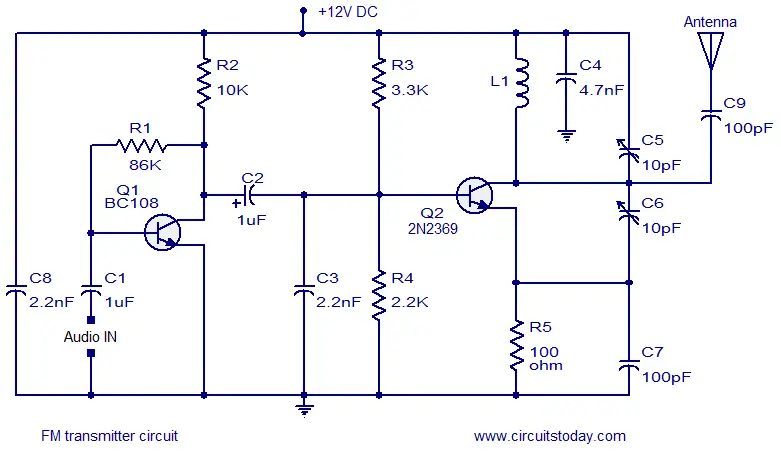
A lot of FM transmitter circuits have been already published here. This just another one, a simple two transistor FM transmitter.The first stage of the circuit is a preamplifier stage based on transistor Q1. This is a collector to base biased amplifier stage where resistor R2 sets the collector current and R1 provided the necessary collector to base bias. C1 is the input DC decoupling capacitor which couples the input audio signal to the Q1 base. C8 is the power supply by-pass capacitor. Next stage is the oscillator cum modulator stage built around transistor Q2. Electrolytic capacitor C2 couples the output of the first stage to the second stage. R3 and R4 are the biasing resistors of Q2. R5 is the emitter resistor of Q2. Inductor L1 and trimmer capacitor C5 forms the tank circuit which is necessary for creating oscillations. The modulated FM signal is available at the collector of Q2 and it is coupled to the antenna using capacitor C9.

Circuit diagram.

simple fm transmitter
Simple FM transmitter circuit

Notes.

  • The circuit can be powered from anything between 6 to 12V DC.
  • Using battery for powering the circuit will improve the performance and reduce noise.
  • A 9V PP3 battery is a good option.
  • If you are going with a battery eliminator, then it must be well filtered and regulated.
  • Trimmer C5 can be used for adjusting the transmission frequency.
  • Antenna can be a 1m copper wire.
  • L1 can be constructed my making 4 turns of 1mm enameled copper wire on a 10mm diameter plastic former.
  • Trimmer capacitor C6 can be adjusted for obtaining the maximum range.
  • Most of the components required for this circuit can be procured from your junk box.

Spy Robot


Remote Operated Spy Robot Circuit


Here is a remote operated spy robot circuit which can be controlled by using a wireless remote controller. It can capture audio and video information’s from the surroundings and can be sent to a remote station through RF signals. The maximum range is 125 meters. It overcomes the limited range of infrared remote controllers. This robot consists of mainly two sections. They are explained in detail below.

Remote Control Operated Spy Robot Circuit – Block Diagram

Remote Control Operated Spy Robot Circuit - Block Diagram


1. Remote Control Section


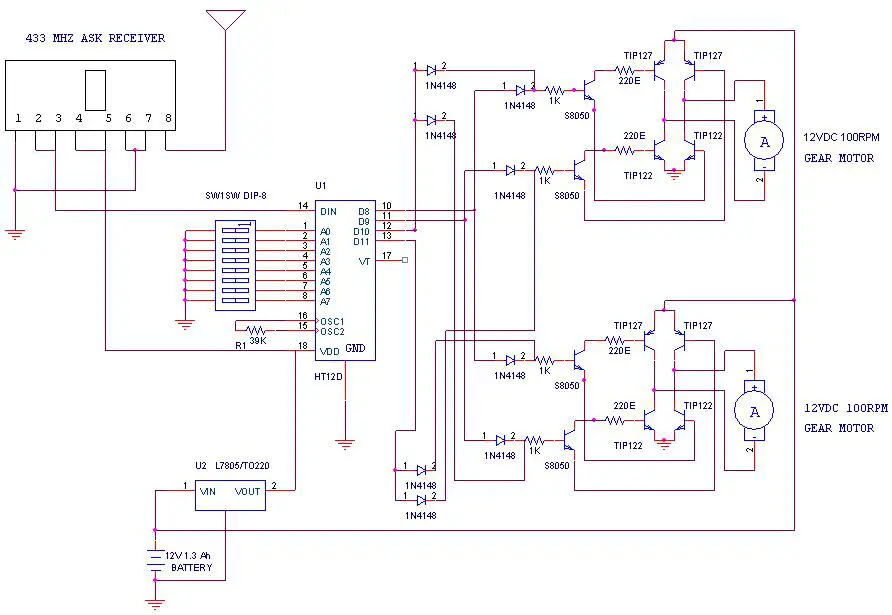
The circuit uses HT 12E, HT 12D encoder and decoder. 433MHz ASK transmitter and receiver is used for the remote control. H-bridge circuits are used for driving motors. Two 12V DC/100RPM gear motors are used as drivers. The working of the circuit is as follows. 


When we are pressing any key in remote controller the HT 12E generate 8 bit address and 4 bit data .The DIP switches are used for setting the address. Then the ASK transmitter sends the 8 bit address and 4 bit data to the receiver Then the ASK receiver receives the 8 bit address and 4 bit data and HT 12D decoder decodes the data, thus enabling the appropriate output. Thus the output signals that are generated controls the H-bridge which then rotates the motors. 


The 433 MHZ ASK transmitter and receivers are extremely small, and are excellent for applications requiring short-range RF remote controls. The transmitter module is only 1/3rd the size of a standard postage stamp, and can easily be placed inside a small plastic enclosure. The transmitter output is up to 8mW at 433.92MHz. The transmitter accepts both linear and digital inputs and can operate from 1.5 to 12 Volts-DC, and makes building a miniature hand-held RF transmitter very easy. The 433 MHZ ASK transmitters is approximately the size of a standard postage stamp 


433 MHZ ASK receivers also operate at 433.92MHz, and have a sensitivity of 3uV. The receiver operates from 4.5 to 5.5 volts-DC.
Remote-Control-Operated-Spy-Robot-Circuit-Remote-Control-Section

2. Video Transmission Section


In this project we are using a wireless CCD camera. Now these types of cameras are commonly available in the market. It works on 12VDC supply. 


To know more about CCD camera, click on the link below.

The 12 Volt DC supply is taken from the battery placed in the robot. The camera has a receiver, which is placed in the remote station. Its output signals are in the form of audio and video. These signals are directly connected to a TV receiver or a computer through a tuner card. 
Remote Operated Spy Robot - Remote Control Section

Components Required

ICHT 12E1
HT 12D1
LM 78052
TRANSISTORTIP 1274
TIP 1224
S 80504
DIODE1N 41488
RESISTOR1K4
220E4
39K1
1M1
ASK TRANSMITTER433 MHz1
ASK RECEIVER433 MHz1
DIP SWITCH2
PUSH TO ON SWITCH4
GEAR MOTOR12V DC 100rpm2
BATTERY12V 1.3 Ah   rechargeable1
9V1
WIRELESS CCD CAMERA1


Construction

T


he steps for the construction are… 


1. Take a hylam sheet with (20cm*15cm) size. 


2. Fix two gear motors (12VDC 100rpm) in the hylam sheet by using aluminum pieces and nut bolts as shown in the figure below. 


3. Fix the ball castor as shown in the figure below.
Construction of Remote Operated Spy Robot Circuit
4. Then fix the battery (12VDC 1.2Ah) on the top of the spy robot as shown in the figure below.


Construction of Remote Operated Spy Robot Circuit – Top View


5. Connect two motors to the PCB. The PCB is then connected to the battery.


6. Connect the wireless CCD camera to the battery.


7. Connect the camera receiver to the TV or computer. Video information’s will thus appear in the screen.


8. Switch on the remote controller and control the spy robot.


source:


http://www.circuitstoday.com

Hybrid Cars


Working Of Hybrid Cars


Hybrid Car Block Diagram

In our busy lives, cars are sought out to be one of the best modes of transportation. But, with the rising economy, people tend to buy cars that have better mileage. But still we think of trading cars with something that is cheaper when we look at the rising petrol costs. Though we do not think much about the environmental effects, we must still consider the fact that cars are the major contributors to pollution. To an extent, hybrid cars can be a remedy to many of these problems. A lot of car manufacturers have started new plants to produce their own version of hybrid cars.
As a matter of fact, we have seen many versions of hybrid vehicles before. Some of them are the simple motorized-pedal bike (moped), pulling trains, diesel-electric buses, and diesel-electric mining trucks and so on. A moped is actually a combination of gasoline and pedal power. Diesel-electric buses run on diesel for a while and later when connected to overhead electric wires, they run on electricity. The submarines used by our country are also hybrid models, where their fuel may be either nuclear-electric or diesel-electric. Some of the earliest hybrid cars include Toyota Prius (1997), Honda Civic Hybrid (2002), and later on many more. Ford Company introduced the first hybrid SUV called The Escape in 2004. Similarly came companies like Chevrolet Silverado and so on.
In this post we are going to give you a detailed explanation on how hybrid cars work, their efficiency, advantages and disadvantages.

What are hybrid cars?

In simple words, the word hybrid refers to anything that has a combination of two different ideas. When a car uses two different ideas to move, it is called a hybrid car. Usually our cars run on petrol, diesel or gas. But their inefficiency, as explained earlier, led to the invention of electric cars. But, since electric cars also had disadvantages of frequent battery charging and inefficient long drives, there evolved a combination of both. When gas and electricity were used in the combined mode, a better solution was made to the inefficiency and mileage.
A user of a car always asks for some minimum requirements while using a car. They are
  • For long distances, the car must run for at least 450 kilometres before refuelling.
  • The drive should be smooth and easy.
  • The car should maintain a good speed so as to cope up with other cars in traffic.
  • Easy and fast refuelling of cars.
  • A good mileage
  • Less pollution
Though most of the conventional cars can provide the first four requirements correctly, they are very much backwards in the case of mileage and pollution. Electric cars, on the other hand can provide a very good mileage and very less pollution. But, the first four requirements will be let down. A combined use of both electric and gas energy will clearly find all these requirements satisfactory.
As Hybrid cars use two energy sources, a lot of energy consumption was reduced for travel (As both the gas and electricity share their energy.) As explained in my article about electric cars, there would not be a disadvantage of recharging the battery frequently. They will be spontaneously charged, while the car is running. Apart from the mileage, the car has also proved to give a performance almost adequate to a conventional car. Due to its improved mileage and reduced pollution, the governments in most countries have been pleased and have helped in its promotion.

Parts Of a Hybrid Car

There are mainly 5 essentials for a hybrid car. They are
  1. Conventional car engine – It can be a gasoline engine or also petrol or diesel respectively. But whatever engine is used, will be more advanced than the usual ones, as they have to work together with the electrical system. They will be smaller with greater efficiency and lesser emissions.
  2. Fuel Tank – For storing the fuel needed to rum the car engine.
  3. Batteries – Batteries are needed to store and release energy as required by the car. The energy from the battery is taken by the motor.
  4. Electric Motor and generator – Though motors can act as generators, both of them are needed for this car. A motor will be needed to take energy from the batteries and accelerate the car. Generators, on the other hand, are needed to produce the electrical power.
  5. Transmission System – The entire transmissions that were performed in a conventional car will be done here as well, but in the hybrid manner.

Series and Parallel Hybrids

There are mainly two types of hybrid cars – Series and Parallel. They differ in the manner in which the two energy sources are combined.
The series hybrid has the generator driven by the engine. This generator is used to charge the batteries and also drive the electric motor, which drives the transmission. Thus power to the vehicle is never directly given by the engine.
Parallel hybrid, on the other hand has both the engine and the electric motor to drive the transmission at the same time. This transmission is then used to turn the wheels. The fuel is given to the engine and the motor is supplied power by the motor. Parallel hybrids are considered straight forward, and hence are used widely. Take a look at the block diagram of a Hybrid Car.

How Hybrid Cars work?

To know the working of a hybrid car, we must understand the basics of Mild Hybrid cars and Full Hybrid cars.
In mild hybrid cars, the electrical motor is used only when additional power is needed. The conventional engine is used to provide most of the power. The electrical motor alone cannot operate the vehicle. Whenever power is needed the electric motor acts as a side-kick to the conventional engine. Some vehicles that carry this concept is the Honda Civic and Insight.
In a full hybrid car, the electrical energy is used while the car needs less power. The gasoline energy is used when the car needs less power. Thus at lower speeds the battery drives the vehicle and at higher speed the gasoline drives the vehicle. This technology has been used in cars like Toyota Prius and Ford Escape.
Both of them though have a little different mode of operation provide the same amount of efficiency.
Since both electric motor and an engine are used simultaneously, the size of the engine will be considerably smaller than the usual ones. But they will be a lot more advanced than the usual ones. The motor, on the other hand is also used to give power for the air conditioner, power windows, water pump and also power steering.
Take a look at the diagram given below. It shows the actual working of the hybrid car Toyota Prius. During the starting position, none of the system is working. After the car starts to move, it is in the normal driving mode. Thus the car will automatically change to the use of electric motor. Later when the car is accelerated and gains speed, it switches from the use f motor to the use of engine. Thus the gasoline engine supplies the required power. This switching is carried out automatically, with the help of an on-board computer. Since the battery has lost some of its charge, it needs to be immediately recharged. This is also done automatically. When the car starts to go in a uniform speed or when it is descending a road, the generator starts charging the battery.

Working of Hybrid Cars

Comparison between a hybrid car and a gasoline car

If you compare the power drive of both the cars, you will see that both of them are equally efficient. While a gasoline car has a bigger engine, the hybrid car has a smaller engine. Conventional cars have enough power to attain the required speed, and that too at the required time. In a hybrid car, as the engine is smaller, it is more efficient. It has lighter parts and reduced number of cylinder. The fuel required for smaller engines is lesser than the other ones. Since bigger engines have all the pistons in a bigger size, they need more energy when they make an up and down movement in the cylinder. Even if the car is not moving, the engine may be on. At this time also the big engine cylinders use fuel.
If both the cars are moving equally the car with gas engine will use its whole single power to drive the car. The hybrid car will also need the same output power to drive the car. But, as it is smaller, it makes lesser power than the bigger one. This is when the electric motor comes into play. They provide the rest of the power from the battery to compensate the balance.

Advantages Of Hybrid Cars

  • Very less pollution.
  • Better mileage.
  • More reliable and comfortable.
  • Very clean cars due to less emissions.
  • Batteries need not be charged by an external source.
  • Warranties available for batteries as well as motors.
  • Less dependence on fuels.

Disadvantages Of Hybrid Cars

  • The initial cost will be very high – higher than other cars.
  • Since a lot of batteries will be needed, the car will be very heavy.
  • As there are electrical components, there is risk of shock during an accident.
  • The vehicle can be repaired only by professionals.
  • Spare parts will be very costly and rare.

Tips to improve fuel efficiency

  1. Most people buy tires that provide good traction for all weather conditions. Little do they look out for efficiency. If stiffer tires with higher pressure are used they reduce the friction by two times than the usual.
  2. For any car, as the weight and size of the car increases, the efficiency decreases. So remove the unwanted weight and thus increase efficiency. Make the body using lighter metals like aluminium and magnesium.
  3. Aerodynamics plays an important role in the fuel consumption of your car. For this you have to reduce the frontal area of the car, thereby reducing the air drag.
  4. The energy wasted from your hybrid car includes the energy wasted as heat. If you could recycle that energy and reuse it, you can surely get more fuel efficiency. When you apply brakes, you are throwing out energy from the car. This energy can be stored in the battery through a process called regenerative braking. Instead of applying the brakes, the electric motor drives the hybrid to reduce the speed of the car. This way, the electric motor acts as a generator and charges the batteries while the car is slowing down.

Selecting a hybrid car

It is indeed a very tricky task to select a hybrid car that suits all your requirements. There are certain basic parameters that you must look out for while buying a hybrid car.
  • Price
As told earlier hybrid cars have a much more initial expense than the ordinary ones. Hybrid cars range in prices from $20,000 to $50,000. The price varies according to the size of the car and also the style. So, decide wisely as this is a lot of money.
  • Mileage
Clearly, hybrids have a lot more mileage than the conventional cars. But still try to buy cars that have better mileage among the category. There are cars with mileages varying from 65mpg to 28 mpg.
  • Travel comfort
For long distance traveling, travel comfort plays a very important role. There are cars with comfortable hatchback and others with leg room, boot capacity and overall space. But to get all these features in one car is a little difficult. So begin a massive search for them.

Selasa, April 02, 2013

1.2 - 12V / 1A Low Voltage Power Supply Using LM317 LED Indicator

Free Electronic/electric Circuit diagram for many electronic project, electrical project and electromachanical.


Project Description

This is a 1.2 - 12 V, max 1A power supply with a low voltage indicator LED. The indicator part includes three diodes and one LED. For example you are charging a battery, you can observe the charge status at that moment. Another advantage of this circuit, when the drawn current exceeds 1A (practically 0.85A), the current protector in LM317 intervenes and LED indicator warns you about the very low output voltage.

Be careful while choosing the transformer. Most of the products are specified as 10VA but their outputs are not as said.

Another good property of this circuit is the mains noise does not pass to the DC part.


Popular Project

Another Project Blog

Project From Diff Blogger

Links

How to Find the other Websites of a Person?


DomainTools

Whois Source Logo


BetterWhois.com: Search ALL Domain Registrars

Webcams.travel - The Webcam Community - Home